
What better industrial lighting can improve
Clearer task visibility
Lighting is planned around racking, routes, machinery and real working areas.
More useful zoning
Control strategy can target lit areas more sensibly across the site.
Less wasted run time
Upgraded controls can reduce unnecessary operating hours in quieter areas.
Lighting planned around real working areas
Industrial lighting has to do more than brighten a building in a general sort of way. In warehouses and production spaces, the layout of working areas, racking, machinery, walkways and task points all affect what good lighting looks like. We carry out warehouse lighting installation work with those practical conditions in mind, considering mounting height, light distribution, switching zones and how the space is actually used. Done properly, the result is not just a brighter roof. It is a site where people can see what they are doing more clearly, where controls make more sense and where the lighting works with the operation instead of simply being present above it.

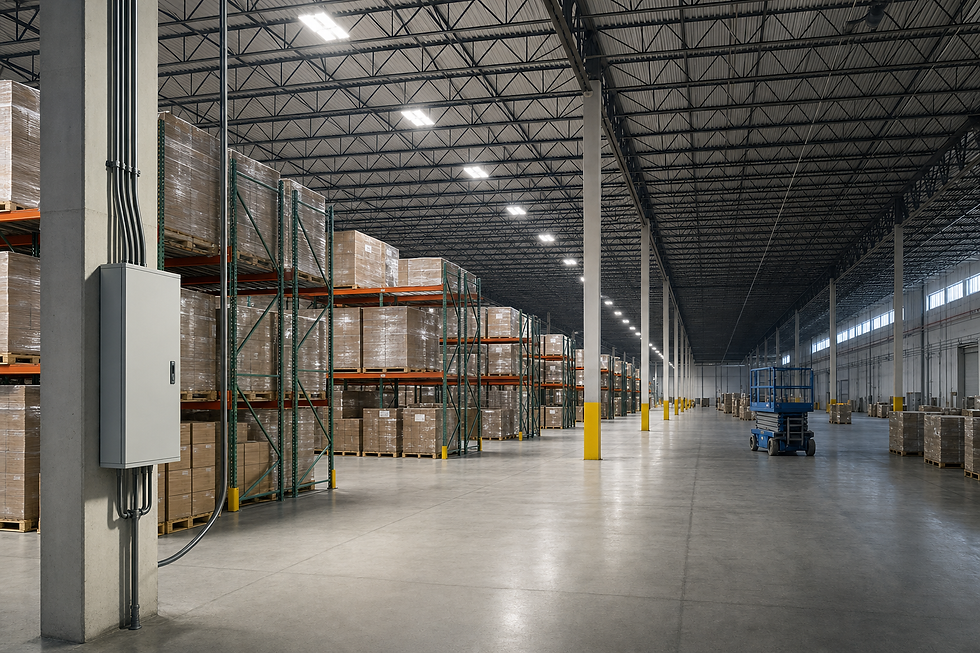
Replacement and control upgrades that work harder
We bring documented experience with Philips Green warehouse lighting installations, including built-in routers and wireless network control. That kind of setup can support more useful zoning and reduce unnecessary operating hours where areas do not need to be lit the same way all day. We also plan access and circuit changeovers around occupied warehouse and production areas so replacement or upgrade work can be managed sensibly. When lighting is improved in a working industrial space, the goal is practical benefit on the floor, not just a new fitting and a promise that it is probably brighter than before.
Frequently asked questions
Can you replace warehouse lighting while the site is occupied?
Yes, where access and working arrangements are planned properly. We can look at how the area is used, what access equipment is needed and how circuit changeovers should be timed so the work fits around live warehouse or production activity as far as possible.
What affects the result of an industrial lighting installation?
Layout, mounting height, light distribution, switching zones and the control strategy all play a part. The best result comes from understanding the working areas and tasks on the floor, not simply counting fittings and spacing them evenly.
Do lighting upgrades help with energy use and control?
They can. Better zoning and smarter control mean lights do not need to run the same way across every area all the time. The main benefit is more useful light where it is needed, with less needless operating time where it is not.