
Why remedial work needs proper structure
Defects become actions
Reports are converted into defined corrective work instead of staying theoretical.
Priorities stay sensible
Safety, production impact and downtime needs shape the repair order.
Records are updated
Checks and completion notes help close out the work clearly.
Turning defect reports into practical corrective work
Electrical remedial work is the point where observations on a report become actual improvements on site. We take defect schedules, known issues and inspection findings and turn them into a defined programme of corrective work. On industrial sites that can include repairing damaged wiring, improving poor connections, replacing unsuitable components, correcting circuit protection and putting right containment faults. If another company has already completed the testing, that is not a problem. We can review the findings, investigate what is on site and carry out the remedial work needed so the defects are dealt with properly rather than living on as permanent fixtures in the maintenance folder.
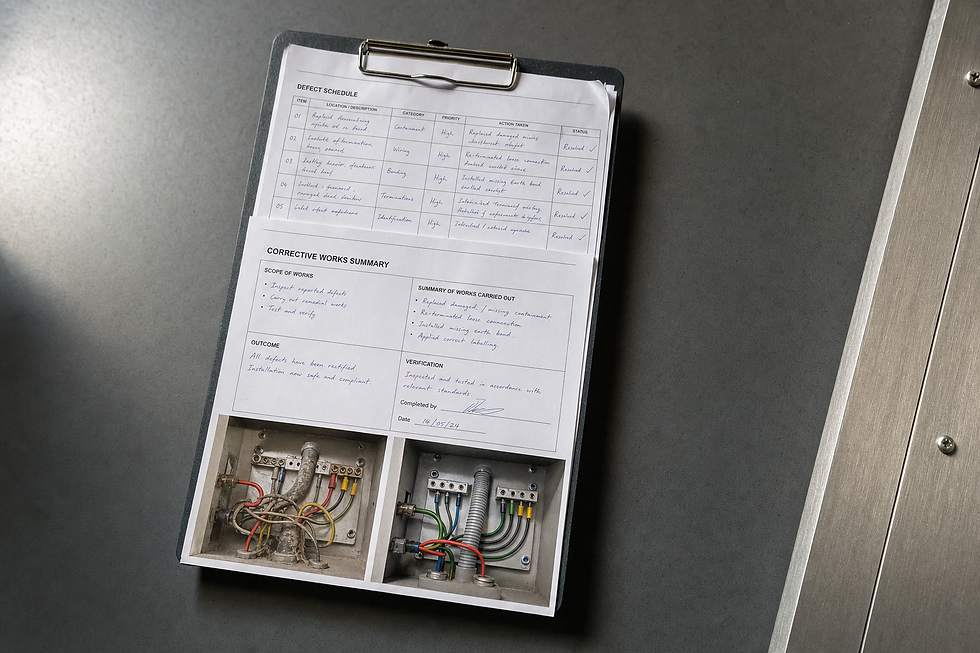
Prioritised by risk, impact and shutdown needs
Good remedial work starts with clear references. Defect schedules, circuit details, equipment information and site-access notes all help locate each item and assess what is needed. From there, the work can be prioritised by safety significance, operational impact and the shutdown required to complete it. We review the reported defects, investigate the site condition, carry out the corrective work, complete the relevant checks and update the completion records. That gives you a clearer route from report to resolution, instead of a growing list of issues everyone means to sort when things are quieter.
Frequently asked questions
Can you carry out remedial work from another firm's report?
Yes. If inspection or testing has already been completed by another company, we can review the defect information, assess the site condition and carry out the corrective work needed. Clear references and defect descriptions help the process move much more smoothly.
What kind of industrial defects can remedial work cover?
Common examples include damaged wiring, poor connections, unsuitable components, incorrect protection and containment faults. The exact work depends on the defect list and what is found on site, but the aim is always to correct the issue in a practical and traceable way.
How do you decide what should be done first?
We look at the safety significance of each item, the operational effect it has on the site and the shutdown or access needed to carry out the work. That helps set an order that is both responsible and realistic for the way the plant is running.